
Old Meissen
Founded in 1710 as Europe’s first porcelain manufactory, Meissen established the standard of excellence in porcelain, standing for artistic mastery ever since.

Neptune - the God of Water and the Seas


Neptune, standing in a shell-chariot, in his left hand a bronze trident, in his right hand a garland. He is escorted by Triton and Nereid, behind him the goddess Thetis. The curved base is richly decorated with heads of dolphins, putti, and shells.
Very fine and rich polychrome decoration with gold.
Johann Joachim Kaendler made this group for Tsarina Catherine the Great. This group is one of the earliest pieces
and probably the first group ever made by Meissen for the Great Order of the Tsar´s court in St. Petersburg.
Swordmark with point (so-called Punktzeit, which ends in 1773, the time when Johann Joachim Kaendler made
the first groups of Neptune and Amphitrite for the Tsar´s court). Meissen abt. 1773
Height: 47 cm, Width: 59 cm, Depth: 24 cm
Triumphal Procession of Amphitrite


Amphitrite, the goddess of the sea and wife of Poseidon, is in a sitting position. She is wearing a crown and holding a scepter in her hand. She is having a scarf to an arch, with three putti. She is also escorted by other putti, Triton, and Nereid.
The curved base is decorated with waves, shells, dolphins, and a turtle. Very fine polychrome decoration with gold.
Johann Joachim Kaendler designed this extraordinary group in 1772-1773 for the Russian Empress Catherine the Great.
Swordmark, Meissen abt. 1910
Height: 49 cm, Length: 58 cm, Depth: 24 cm
The three Paraces


On a pyramidal triangle base, the three goddesses of fate, Clotho, Lachesis, and Atropos. Clotho and Lachesis are spinning the thread of human life, and Atropos is trying to cut it with scissors. Chronos, behind her, is stopping her. Fine polychrome decoration.
Design by Johann Joachim Kaendler 1774
Swordmark, Meissen abt. 1880
Height: 36,5 cm, Width: 37,5 cm, Depth: 15,5 cm
Apollo and Minerva


Apollo, the son of Zeus and Leto, God of light and the sun, truth and prophecy, medicine, healing, music, poetry, and more,
triumphs over the Dragon Pyton and the personification of envy. To his site, Minerva, the goodness of the tactical war.
Fine, colorful, and gold decoration.
Design by Johann Joachim Kaendler, 1774, for the Russian Empress Catharina II.
Swordmark, Meissen 2nd half 19th century
Height: 39 cm, Length: 35 cm, Depth: 17,5 cm
The Three Graces


Oval base with an ornamental and floral edging. The three graces in sitting and standing positions, clothed in a scarf.
One holding a bow in her right hand and an arrow in her left hand. Besides the graces, a putto and two love-birds.
Fine polychrome decoration with gold.
Signed at the base: E.Andresen
Swordmark and model No. O190, Meissen abt. 1900
Height: 36 cm, Width: 36 cm, Depth: 26 cm
Apollo and Daphne

Extraordinary Large Meissen Group "Apollo and Daphne". Each standing on a rococo base, Apollo, wearing a purple cape, tries to catch Daphne, who transforms into a laurel tree. This group is manufactured in two pieces, combined into one massive group.
It was designed with 8 other groups as a table decoration for the “Vestunen dinner set”. Frederick the Great, King of Prussia,
ordered this dinner set and the nine Meissen groups for one of his palaces. Polychrome decoration with gold.
Design by Johann Friedrich Eberlein abt. 1740.
Swordmark, Meissen abt. 1880
Height: 38,5 cm, Width: 42,5 cm
Pair of Figure Groups
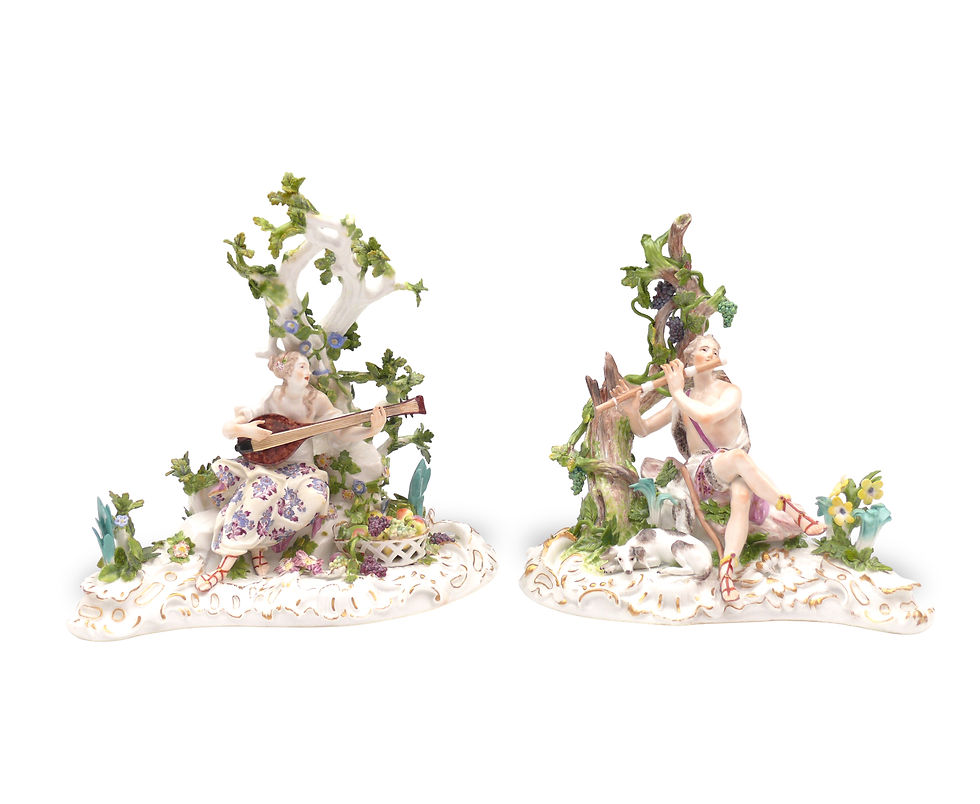


Highly important Pair of Figure Groups for King Frederick the Great, placed on a rococo base, a young, elegant lady, wearing very fine clothes, playing on a lute, behind her a tree with leaves and blossoms, in front of her a basket with apples, pears, and ripe red grapes.
The counterpart, also on a rococo base, is a young, elegant man playing on a transverse flute, behind him a tree with vine tendrils, vine leaves, and grapes. In front of him is a dog. Very fine and rich polychrome decoration with gold.
Design: Friedrich Elias Meyer and Johann Joachim Kaendler.
Swordmark, Meissen abt. 1760
Height: each ca. 26 cm
Meissen Lady with Young Moor


On a hexagonal base an elegant young lady, wearing very fine rococo clothes. Next to her a young moor, wearing elegant traditional clothes. He demands for a bullet, which she is holding in her right hand. Plain decoration mostly in red and orange shades with gold.
Design: Paul Scheurich, 1919
Swordmark, Meissen abt. 1935
Height: 28,5 cm, Width: 26 cm
Pair of Vases Element Earth


The bases in the form of a rock, the Vases of baluster shape, with leafy branches at both sides. At the showside of the body hunting scene with red deer and wild boars, and hunting dogs. On the reverse, an antler with hunting utensils. The cover with the roman goddess of hunting, Diana, with a hunting dog. Lid and vase neck with metal mounting. Polychrome decoration with gold.
Design: Johann Joachim Kaendler in 1741
Swordmark, Model No. 330, Meissen, abt. 1880
Height: 61 cm
Ewer Element Fire


Of baluster form, over a round foot. Large spout and a large handle in the form of a dragon with wings. The ewer carries landscapes with animals, forests with forest fires, and a volcano. Mars, the god of war and agriculture, sits on a rock with several forest animals at his feet. To the other side, a young lady with a torch in her hand. A putto with a torch at the spirally moulded foot in the form of
fire-waves. A putto on the top of the dragon-handle. Very rich and fine polychrome decoration with gold.
The ewer „Fire“ belongs to a set of four element ewers: „Fire”, „Water“, “Earth”, and “Air”, as well as a Royal centerpiece vase, with its allegorical – mythological representation, initially designed as a present for the French King Louis XV. Some invisible restorations.
Design by Johann Joachim Kaendler abt. 1740, Meissen abt. 1880
Height: 69 cm
Ewer Element Water


Of baluster shape, over a round foot, with a large spout and a large handle in the form of sea grass. The ewer carries marine motifs, which include Neptune in a chariot, drawn by sea horses, a nereid, dolphins embellishing the spirally molded foot, and a putto on top of the handle. On the show side, a rich relief scene of sailing ships at sea. Very rich and fine polychrome decoration with gold.
The ewer “Water” belongs to a set of four element ewers: “Fire”, “Water”, “Earth”, and “Air”, as well as a Royal centerpiece vase, with its allegorical – mythological representation, initially designed as a present for the French King Louis XV.
Design by Johann Joachim Kaendler abt. 1740, Meissen dept. 1890
Height: 66cm
Ewer Element Air


Of baluster form, over a round foot, with a large spout and a large handle in the form of a cloud-ribbon. The ewer carries heaven and air motifs, which include Juno, the goddess of the air, sitting on a cloud above a peacock. On top of the handle, two floating putti
play a bagpipe. The spirally moulded foot is decorated with coloured feathers and a floating putto. Very rich and fine polychrome decoration with gold.
The ewer “Air” belongs to a set of four element ewers: “Fire”, “Water”, “Earth”, and “Air”, as well as a Royal centrepiece vase, with its allegorical – mythological representation, initially designed as a present for the French King Louis XV.
Design by Johann Joachim Kaendler abt. 1740, Meissen abt. 1880/1890
Height: 63 cm
Centerpiece "The Four Seasons"


Meissen porcelain Centerpiece “The four seasons” on Stand. Eight putti symbolizing the four seasons, with flowers, fruits, win.e, grain, and fire, sitting on the base. Column with a tendril of flowers. On top of the big basket with flowers outside the basked applied flowers, rich gold decoration all over the basket. Conforming stand with four scroll feet and applied flowers, in cartouches with rich flower decorations and insects.
Centerpiece Swordmark with one scratch
Stand Swordmark without a scratch
Meissen, 2nd half of 19th century
Height: 52 cm
Meissen Mantel Clock Diana


On a fine rococo base Diana the roman goddess of the hunt, countryside and the moon in lying position, on a pillow, wearing elegant rococo clothes, a hat with feather on her head. At her feet a quiver with arrows and a bow. To her right a hunting dog.
A clockwork in form of a globe with Arabic numeral.Very fine and light polychrome decoration with gold.
Design: Paul Scheurich in 1937
Swordmark, Model-No. A1193, Bossier No. 59, Meissen abt. 1937
Height: 28 cm, Width: 37 cm, Depth: 16 cm
Shepherdess and Shepherd


Extraordinary fine Pair of Meissen Figures, mounted on a gilt-bronze three-light candelabrum in fine rococo shape with foliage.
The Shepherdess with a birdcage is standing on a natural rococo base, wearing elegant clothes, decorated with Indian flowers.
In her hands, she is holding a birdcage and a shepherd´s crook. Next to her were two sheep. The Shepherd with a bird nest is
standing on a natural rococo base, wearing elegant clothes. In his right hand, he is holding his hat with a bird nest inside it.
On his left hand, a songbird. Next to him was a herding dog. Both figures are decorated in fine polychrome colors with gold.
The drip trays and the grommet are pierced for a former electrification.
Design by Johann Joachim Kaendler in 1750.
Swordmarks at the base.
Meissen abt. 1750-1760
Dimensions:
Height Shepherdess: 27 cm, Height Shepherdess with candelabrum: 51 cm
Height Shepherd: 25 cm, Height Shepherd with candelabrum: 52 cm
Meissen Potpourri


Standing on a gilt-bronze mount, with three naturalistic goat feet over a triangular base. Under the body of the potpourri a rosette with a pine knob. The rim in gilt-bronze as well with a pierced border. The porcelain vessel in bowl form, the body and the cover decorated with a rich chinoiserie scene within a gilt scrollwork cartouche filled with so called Böttgerlustre and embellished with iron-red and purple scrollwork, flanked by flowering branches of “indianische Blumen”. All four cartouches decorated with
extremely fine and rich “Chinoiserie” decoration. The gilt-bronze mount is a french work, Paris abt. 1750.
without Swordmark, Meissen abt. 1725
Height: 28 cm, Diameter: 20 cm
Bowl with Cover


Round-shaped bowl with two curved handles. Cover with a knob in the form of a winged dragon. The bowl with two gilt polylobed cartouches, embellished with gold and purple scrollwork borders. Inside, superbly painted with European landscapes, one with a “Kauffahrtei” scene with merchants and workers, the other with farmers at work. The cover has three gilt polylobed cartouches, embellished with gold and purple scrollwork borders, as well. Inside, superbly painted with European landscapes, one with a
pastoral scene, two with so-called “Kauffahrtei” scenes. The decoration is executed in polychrome colors.
Swordmark and Gilt-No., Meissen abt. 1728
Height: 12 cm, Width: 15 cm
Vases with Kauffahrtei Scenes


Baluster form Vases. Each with three quatrelobe cartouches, framed by a rich gilt scrollwork as well as gilt scrollwork to the rim.
The cartouches decorated in finest polychrome decoration in the manner of Christian Friedrich Herold with Kauffahrtei scenes, merchants and their wares, architecture, harbor-installations and sailing ships.
Swordmark with star for Meissen Marcolini, Meissen abt. 1774-1814
Height: 27,5 cm
Meissen Tureen with Cover


Cylindrical shape over a bulge stand. To each side a handle in the form of volutes, crowned by a woman´s head. The high domed cover ends in a large artichoke in gold. To the show side, reverse and the both sides of the cover very rich and fine “Chinoiserie” scenes with servants, wearing traditional clothes, Asian vegetation with palm trees, birds, monkey and insects. Below the scenes a gold scrollwork and latticework, filled with “Böttger lustre”. The decoration executed in very fine and rich polychrome decoration in the manner of Johann Gregorius Höroldt. Rich gold decoration. The bottom also decorated in gold.
Swordmark, Meissen abt. 1735
Height: 30 cm
Liqueur Barrel


Important Early Meissen Liqueur Barrel with a purple fond, subdivided with golden lines, ten polylobed cartouches, two decorated with Kauffahrtei scenes in grisaille, four cartouches decorated with Kauffahrtei scenes in monochrome iron-red, four cartouches, decorated with Kauffahrtei scenes as well, in polychrome colors. The front and the back side are decorated with Chinese noblemen, Chinese merchants, and workers in Asian harbors with ships at sea, a mountainous landscape with exotic vegetation, and palm trees.
The decoration was executed in the best quality in polychrome colors by the famous artist Christian Friedrich Herold.
On top, a sitting putto symbolizing Bacchus with wine leaves and grapes, on a brass square. At the front, a bronze tap.
The barrel is standing on a brass stand. The brass square, the tap, and the stand later.
Swordmark, Meissen abt. 1738
Height: 21 cm, Length: 16 cm, Diameter: 13 cm
Snuff Box Collection


This collection comprises several exquisite Meissen snuff boxes, dating from circa 1725 to 1750. The pieces range from early chinoiserie-decorated examples with Böttger lustre and harbour scenes to later Rococo designs featuring floral bouquets, gallant figures, Kauffahrtei scenes, and playful cupids. Gold- and silver-gilt mounts, finely painted polychrome decoration, and unique interior miniatures demonstrate the manufactory’s mastery at the highest level of craftsmanship. With connections to important private collections and parallels to museum holdings in Dresden, London, Copenhagen, and Amsterdam, these snuff boxes embody the elegance and refinement of 18th-century Meissen porcelain, standing as both functional objects and miniature works of art.
Teapot with Cover


Extraordinary Tea Pot with Cover, conical shape, with a grotesque mask below the spout. The body is superbly painted in iron-red monochrome with a hunter on horseback with several hunting dogs hunting a bear in an extensive landscape. Cover with a knob. The decoration executed by the workshop of Ignaz Preissler.
KPM mark, Meissen abt. 1723-1724
Height: ca. 12,5 cm
Teapot Hausmaler Decoration


Of squat pear shape, domed cover, handle in C-form, the curved spout with a grotesque mask. The cover and the pot partly with underglaze blue decoration. Two Chinese gentlemen in a landscape with oriental flowers and trees, exotic birds and architecture in polychrome colors with gold. The decoration almost certainly painted in the “Augsburg Workshop” of Bartolomaeus Seuter.
No Swordmark
Meissen, Bartolomaeus Seuter abt. 1720
Height: 15,5 cm
Art Deco Vase with Cover


Body of conical shape, covered with a ribbon knob. The whole body is elegantly decorated in coral red. In two Art Déco cartouches,
a caravelle, and seagulls in the sky. To each side, a fisherman with a fishing rod, a fish on the hook. A bat flies above him.
The cover is decorated with Renaissance architecture. The shape is designed by Adalbert Niemeyer. Model-No. 208 in 1920.
The vase is decorated by Marianne Meyfahrt, who worked in Meissen between 1919 and 1924.
SwordmarkMeissen abt. 1921
Height: 23 cm
Meissen "Iron-Red" Vase


The finely potted ovoid body rises into a tall, rhythmically articulated neck, culminating in a gently flared rim that enhances the vase’s elegant verticality. The surface is richly ornamented with an intricate iron-red and gilt decoration, inspired by Chinese Kangxi-period prototypes and employing the so-called “Milk and Blood” palette with remarkable precision. Stylised floral scrolls, cartouches, and geometric borders are carefully balanced across the form, demonstrating the high level of craftsmanship characteristic of Meissen’s historicist production. The luminous white ground provides a refined contrast to the warm tones of the decoration, underscoring both the clarity of the design and the vase’s sculptural presence.
Swordmark and No. E 164, Meissen, 2nd half 19th century
Height: 55,5 cm